It’s a recurrent pattern we’ve seen play out across the globe. Countries or states legalize or fully decriminalize the sex trade, saying this promotes the safety and dignity of the women involved. But repeatedly, this rationale fails. Their lofty dream does not play out as planned.
Germany, which has been called the “brothel of Europe” by the president of national parliament of Germany (Bundestag), Julia Klöckner, is one of the countries coming to terms with the failures of legalized/fully decriminalized prostitution.
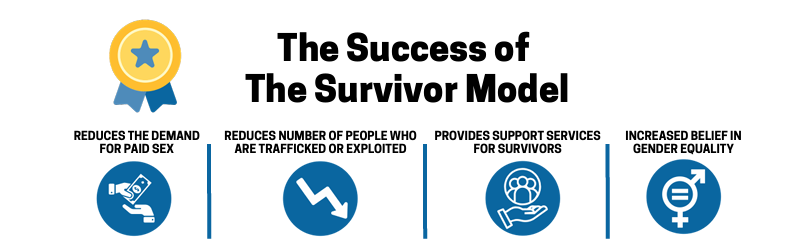
Rather than bringing prostituted women safety or dignity, legalizing or fully decriminalizing prostitution does the inverse. It creates a higher demand for paid sex, incentivizing pimps and sex traffickers to push more unwilling victims into the sex trade.
The 2025 Trafficking in Persons report, published by the U.S. Department of State, erroneously classified Germany as a “Tier 1” country, meaning they fully meet the minimum requirements for combatting human trafficking. Yet even the German government officials themselves recognize this classification is incorrect.
Klöckner and other German leaders, including the Health Minister, Nina Warken, are sounding the alarm about how legalization has “caused the [prostitution/sex trafficking] market to explode in Germany.” Further, it is not even all happening legally. Researchers estimate that the number of unregistered prostituted persons in Germany “ranges from 200,000 to 400,000 at the low end to up to 1 million.” It is believed that most of these are foreign women with poor German language skills, “because they know very little about their rights, they have virtually no access to existing health and support services. Reportedly, the “vast majority” of these women are sex trafficked into the trade.
Klöckner and Warken are calling for the implementation of the Survivor Model (a.k.a. Nordic/Swedish/Equality/Abolition Model) to combat sex trafficking in Germany by criminalizing the exploiters (i.e. sex buyers, pimps/traffickers, and brothel keepers) rather than the exploited (i.e. prostituted persons).
History of Prostitution Laws in Germany
In 2002, the Prostitution Act was passed in Germany, deeming prostitution (inappropriately called “sex work” in the law) a legal service. The intention was for this to give prostituted persons the right to be paid their agreed fee. States were also permitted to prohibit the purchase of sex in certain areas.
Years later, in 2017, attempted to pass further legal protections for prostituted persons. Prostituted persons were required to register their activity with the government and brothels had to get a license to operate, pending they meet safety and hygiene requirements. Further, this law required sex buyers to use condoms when engaging in sexual acts with a prostituted person.
In theory, this sounds like it could be a great way to curb violence and unsafety in prostitution. But this is not what happened.
The Fallout of Legalized Prostitution in Germany
If legalized prostitution in Germany, and other countries, has taught us one thing, it’s that sex trafficking flourishes in countries where prostitution is legal. An analysis of data from 150 countries found that nations where prostitution is legalized reported higher inflows of human trafficking than in countries where it was partially or fully prohibited.
A 2022 study found that 55% of German sex buyers “admitted to having observed or paid a pimp or trafficker.” Sadly, only 1% of them reported this to the authorities, despite the fact that they wouldn’t face criminal penalties for purchasing sex. And a collection of sex buyer testimonies from German feminist, Elly Arrow, tell a disturbing story of how sex buyers really feel about the women they purchase (Strong trigger warning for degrading and disturbing descriptions of sexual violence).
The argument for legalizing prostitution is weak because it is not as if there are swaths of German women who are eager to engage in prostitution. In fact, the numbers tell a story that is quite different.
The Federal Statistical Office of Germany found that there were about 32,300 registered sex workers in Germany at the end of 2024. However, only 5,600 of them were German citizens. A much higher portion were from foreign countries, including 11,500 from Romania and 3,400 from Bulgaria.
According to NCOSE Chief Legal Counsel, Dani Pinter, this paints a picture of exploitation:
“Germany has chosen to legalize prostitution, but very few Germans are choosing to sign up and work in brothels. So, when we’re seeing numbers like [11,500] coming from Romania, it is likely that these are really vulnerable people. Germany is essentially importing really vulnerable people to work in brothels.”
The 2024 National Situation Report on Human Trafficking and Exploitation, published by the German Federal Criminal Police Office (Bundeskriminalamt), also notes that while German is the most common nationality known to report sex trafficking in Germany, this is because German citizens are more likely to know their rights and have trust in the police, rather than immigrants who have little knowledge of Germany’s laws and the language.
Other Places Where Legalized/Fully Decriminalized Prostitution Has Failed
Around the world, other countries have run the experiment of legalized or fully decriminalized prostitution, but just like Germany, they have been faced with the harsh reality of it not working.
Government officials in Japan, including the prime minister, have recently spoken out about the need to eradicate prostitution, as the country has become a popular sex tourism destination.
“It has been reported by overseas media that ‘Japan is a new sex tourism country,’ and the image that ‘Japan is a country that does not protect women’s dignity’ is spreading internationally,” said Shiora Fumika, a member of the Constitutional Democratic Party of Japan.
A few years ago, the Prime Minister of Spain, Pedro Sanchez, vowed to outlaw prostitution, saying that it “enslaves women.” Prostitution was fully decriminalized in Spain back in 1995. Prior to its decriminalization, prostituted women were primarily of Spanish origin, but since the early 2000s, the majority have become migrant women from poor countries, leaving them extremely vulnerable to exploitation.
France and Israel are two of the latest countries to adopt the Nordic model, after years of controversy.
Israel had a system of fully decriminalized prostitution for a long time and in the late 1990s to early 2000s, it became a destination for sex trafficking, as many women fled there from communist countries. Again, this showcases how prostitution is repeatedly used as a way to exploit vulnerable populations.
France outlawed the purchase of sex in 2016. For a long time, France had a system which they called “regulationism” (essentially legalized prostitution), but that was outlawed in France in the mid-20th century. Until 2016, prostitution had been fully criminalized. In March of 2019, France and Sweden (the first country to enact the Survivor Model) released a joint statement about their commitment to reduce the demand for paid sex.
The Survivor Model is the Only Path to End Sex Trafficking
The Survivor Model is the only way to end sex trafficking because the demand for commercial sex will always outweigh the supply of individuals who are willingly engaging in prostitution. This is why nefarious and greedy criminals exploit vulnerable women to meet this demand. As Pinter explains:
“There are some people who want to voluntarily engage, but that’s a small percentage of people. If they can actually do this safely with fully informed consent and agency, they’re usually actually in a very privileged position in the first place. And that’s such a small percentage of people…
And so, we’re not anti-those people but we’re recognizing that this system sweeps in, in large part, vulnerable people, and is drastically exploiting them in really, really harmful ways, and it’s attracting really, really bad actors. When you commodify human beings, it’s just bad for society. It lowers our empathy for each other.”