TRIGGER WARNING: Disturbing discussions of glorified sexual violence
“I didn’t have to provide any ID or anything to verify my age, and see some of the worst pornographic sexualized torture of women I’ve seen. It was pretty bad, some things I saw. I’m talking about games where the scenario is abducting women, holding them hostage, and sexually torturing them. And any child could access that.” ~ Caitlin Roper, Campaigns Manager, Collective Shout
Recently, our friends at Collective Shout in Australia celebrated the success of their campaign urging the removal of nearly 500 rape and incest games from the video game platforms Steam and Itch.io. These games allowed the player to act out explicit acts of violence, rape, and incest against women and children.
The fact that these games have been removed is an incredible victory, which NCOSE unequivocally celebrates and commends Collective Shout for. At the same time, this incident has sparked a surprising amount of controversy and mixed reactions, which have reached national headlines.
As both a gamer and an advocate against sexual violence, I believe I have a unique perspective on this issue and can speak to the various concerns raised from both sides. In this piece, I will walk through the events that led up to the games’ removal, the objections and controversy it sparked, and my response.
“No Mercy”: The Game That Started Everything
This all began with a game called “No Mercy.” This game allows players to “assume the persona of a man who rapes his female family members” with a self-proclaimed “huge focus on incest and male domination.”
Back in March of this year, a male gamer notified Collective Shout about the game and began sending emails to Steam requesting it be removed from the platform. This prompted Collective Shout to invite supporters to email Steam, urging them to remove No Mercy. 3463 emails were sent to Steam to this end; Steam did not respond.
Because of this inaction, Collective Shout then organized a petition for the removal of the game from Steam. 70,000 people signed this petition, yet no action was taken.
Ultimately, the developer of the game (not Steam) pulled No Mercy from the platform on April 11th.
Steam Removes 500 Rape/Incest Games, Itch.io Delists 20,000 NSFW Games
Supporters of this campaign continued to email Steam leadership to remove ALL rape/incest games, which were counted as nearly 500 games by Collective Shout’s team. Steam did not act on these emails.
Due to this lack of response from Steam, Collective Shout decided to launch a movement on May 26th to inform payment processors about these rape and incest games and request they stop funding them. A total of 1067 emails were sent to the payment processors, yet no action was taken.
A few weeks later, Collective Shout crafted an open letter with eight global partners and experts to mainstream payment processors. NCOSE was a proud cosigner of this letter calling on these processors to stop profiting from rape and incest games.
“These games endorsing men’s sexualized abuse and torture of women and girls fly in the face of efforts to address violence against women. We do not see how facilitating payment transactions and deriving financial benefit from these violent and unethical games, is consistent with your corporate values and mission statements,” the letter states. “We request that you demonstrate corporate social responsibility and immediately cease processing payments on Steam and Itch.io and any other platforms hosting similar games.”
Five days after this letter was sent, Steam implemented a new policy stating developers cannot publish “content that may violate the rules and standards set forth by Steam’s payment processors and related card networks and banks, or internet network providers. In particular, certain kinds of adult only content.” It was after the implementation of this policy that Steam began deleting rape and incest games.
Here are a few examples of the games removed from the platform:
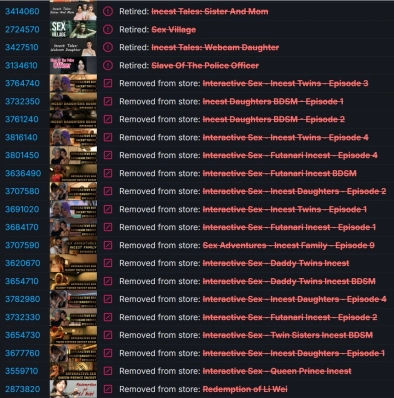
In response to pressure from payment processors, Itch.io delisted all 20,000 NSFW games for review. This led to a surge in abuse toward Collective Shout, including doxxing and violent threats.
Collective Shout Team Harassed After Games’ Removal
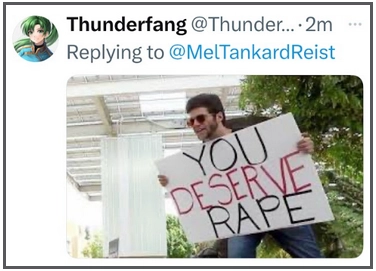
There has been an unconscionable level of aggressive threats launched against the women at Collective Shout, after Steam and Itch.io took action. These women have received death and rape threats, including threats to their children.
This is inexcusable behavior. It also ironically serves to prove Collective Shout’s point that games like these fuel or at least cater to aggressive attitudes and behaviors.
Nothing merits the kind of blatant harassment, threats, and blackmail that these people have sent to Collective Shout. The content they have sent these women includes some of the worst statements I’ve seen in my life.
In response to the backlash, Caitlin Roper stated, “The intention is to make us frightened, to make us fearful, and to get us to shut up. We’re not going to be threatened and bullied out of advocating for women and girls.”
Responding to Concerns from the Gaming Community
Some in the gaming community express concern that this could lead to the censorship of other games, such as ones displaying violence or LGBTQ+ themes. But there is really no comparison to generally violent games or LGBTQ+ content and this violent and hateful content targeted at women.
Games like No Mercy encouraged players to sexually torture every female character and rewarded them for doing so. It was promoted with language like “Become every woman’s worst nightmare.” My colleague, Lily Moric, proposed an interesting thought experiment here:
“Imagine that, instead, the game was designed to have people hunt down and torture every LGBTQ character, or every person of color. Would we not vehemently condemn such a game and call for its removal? Why then, should it be different, if the game’s target is women?”
This isn’t about censorship, it’s about protecting women and girls by not promoting games based on their sexual torture. It is actually content like this that silences and suppresses women, making them feel unwelcome in the gaming community and afraid to speak up. The extreme backlash from fans of these games threatening the female advocates with rape and death threats demonstrate this reality. This is why I have decided not to put my name on this blog.
Rape games place the user as the rapist, enabling them to virtually sexually abuse another character, turning them into an active participant. Arguing that removing rape games will somehow lead to the censorship of all violent or LGBTQ+ content is a Chicken Little argument. It misrepresents the purpose of this campaign and suggests that sexual abuse games are the necessary price we must pay to protect creative freedom, which is both ethically flawed and logically false.
Another concern raised by the gaming community is that this incident shows payment processors have too much power. However, like any business, it is within payment processors’ right to cease supporting content that harms their brand, violates policies, or increases liability. If they don’t want to fund rape and incest games, they don’t have to.
Others worry that the current Steam policy on content alignment with payment processors is too vague and could lead to unwarranted removal of games that people have spent time and money on. This is something I agree with. Steam should create a more clear and robust policy, and that policy should also emphatically clarify that games based on themes of sexual coercion, sexual abuse, or sexually explicit content are not allowed.
“It’s Just A Game”
The majority of gamers do not defend the rape games themselves, and are instead focused on payment processors having too much power and how this could lead to censorship of other content. However, there is a minority of people who do defend the rape games, claiming it is “just a game” and isn’t hurting anyone. Yes, it is a game … but does that really mean it isn’t hurting anyone?
On the contrary, research shows that sexually violent media can and does lead to increased acts of sexual aggression in real life, as well as attitudes supporting sexual violence. For example, a three-wave longitudinal study found that adolescents who consume “violent X-rated material” are 6x more likely to become sexually aggressive later on in life. An experimental study that controlled for causal order found that playing video games depicting violence against women and sexual objectification of women led to increased acceptance of rape myths among male participants (rape myths include beliefs such as “Women like being raped” and “If she’s wearing a short skirt, she’s asking for it”).
I’m a gamer, and I understand that video games tell a story. They are some of the most powerful forms of storytelling I’ve ever experienced. They can immerse you in a world that you’ve never seen before, teach you things you couldn’t have learned any other way, and introduce you to characters that inspire you to emulate them.
These games can change us to be who we are. So, we must consider, why is there a market for rape and incest games in the first place? What does that say about us? About who we are becoming?
A Ray of Light
When asked what keeps Caitlin and all the other women at Collective Shout going despite the abuse, she said:
“Through all the threats and the abuse, there will be a little glimmer, and it will be a message from someone, and it’ll say, ‘I’m a survivor, thank you, this means so much that you’re doing this.’ And I say to myself, ‘That’s right. We can get all the hate and the abuse and the contempt and anything else, but this is why we do what we do. We do it for the women and the girls and for people who value our human rights.’
“At the end of the day, if we’re able to make a difference, that means the world to a lot of these women, and that’s who we’re fighting for.”