Jane Doe was eight years old when she started playing on the popular gaming platform, Roblox. The platform was marketed for children and claimed to be safe, so Jane Doe’s mother thought it would be an acceptable option for her child.
After Jane joined Roblox, she met another “child” on the platform who wanted to play with her. Over time, they developed a close friendship.
But slowly, things took a frightening turn. Jane’s new “friend” kept asking Jane where she lived and whether her parents were home. They encouraged Jane to keep secrets from her parents. They began sending her graphic messages and sexually explicit images. And eventually, Jane’s “friend” convinced the eight-year-old girl to reciprocate, sending sexual images in return.
These are the events which led Jane Doe and her mother to file a lawsuit against Roblox, alleging that the platform’s misleading messages about safety coupled with its factually dangerous product design make it a “breeding ground for predators.”
The reality is, Jane is only one of countless children who have been sexually exploited due to Roblox’s negligence. And finally, the world is starting to pay attention.
What is Roblox and Why is it Under Fire?
Roblox is one of the most popular gaming platforms in the world, boasting approximately 380 million monthly active users. It’s marketed as a fun, creative playground for kids but in reality, it’s an unsafe digital free-for-all where predators can and do prey on children.
More than 40% of Roblox’s user base is under 12 years old. Yet Roblox has become a hotbed of grooming, sexualized content, and private chat systems that enable direct contact between strangers and children.
These issues have been well-documented over years, but outrage has recently spiked online when Roblox sent a cease and desist to, and banned YouTuber Michael Schlep, who is known for exposing sexual content and alleged child predators on the platform. Schlep has reported that he was groomed by a Roblox developer between the ages of 12 and 15 which led to his passion to catch similar predators. Roblox said it does not permit “vigilante” activity. Many online are criticizing Roblox for banning vigilantes, instead of doing more to ban child predators.
Amid this online debate, it is important to realize that Roblox has a long history of prioritizing profit over child safety and of failing to initiate comprehensive reform.
This status quo cannot continue.
Roblox Is Lobbying Against Child Protection
Instead of fixing these glaring safety gaps, Roblox has been working behind the scenes to fight legislation that would hold them accountable.
Louisiana State Representative Laurie Schlegel recently revealed:
“For the last couple of years, I have passed a number of child online protection bills. And every year, Roblox hires lobbyists to oppose and actively work to stall my bills. This session, a Roblox executive personally came down to Louisiana to work against my Duty of Care bill. For a platform that has been described in the news as having a pedophile problem, you would think Roblox would make drastic changes. But they have consistently shown they put profits over child safety.”
Even members of Congress are starting to take notice. Rep. Ro Khanna (D-CA) recently launched a petition to “Save Roblox” calling on the company to implement stronger child safety measures. Khanna’s petition cites mounting reports of inappropriate content and predator activity on the platform, echoing what parents, advocates, and law enforcement have been warning for years.
It’s telling that federal lawmakers are turning to public pressure campaigns just to get a multibillion-dollar corporation to take child safety seriously. Roblox has had years of warnings — from NCOSE and other advocates, journalists, and now Congress — yet continues to resist meaningful reform.
Louisiana Sues Roblox for Enabling Child Exploitation
Louisiana Attorney General Liz Murrill has filed a child protection lawsuit against Roblox, alleging the platform has “facilitated the distribution of child sexual abuse material and the sexual exploitation of Louisiana’s children” while “knowingly and intentionally” failing to implement even basic safety controls.
Murrill’s filing states that Roblox is “overrun with harmful content and child predators because it prioritizes user growth, revenue, and profits over child safety.”
She warns:
“Every parent should be aware of the clear and present danger posed to their children by Roblox so they can prevent the unthinkable from ever happening in their own home.”
The lawsuit cites disturbing examples, including games with simulated child gang rape, a 3,334-member group openly trading child pornography, and a Louisiana man caught using Roblox with voice-altering software to lure minors while possessing child sexual abuse material.
A Long-Standing, Well-Documented Danger
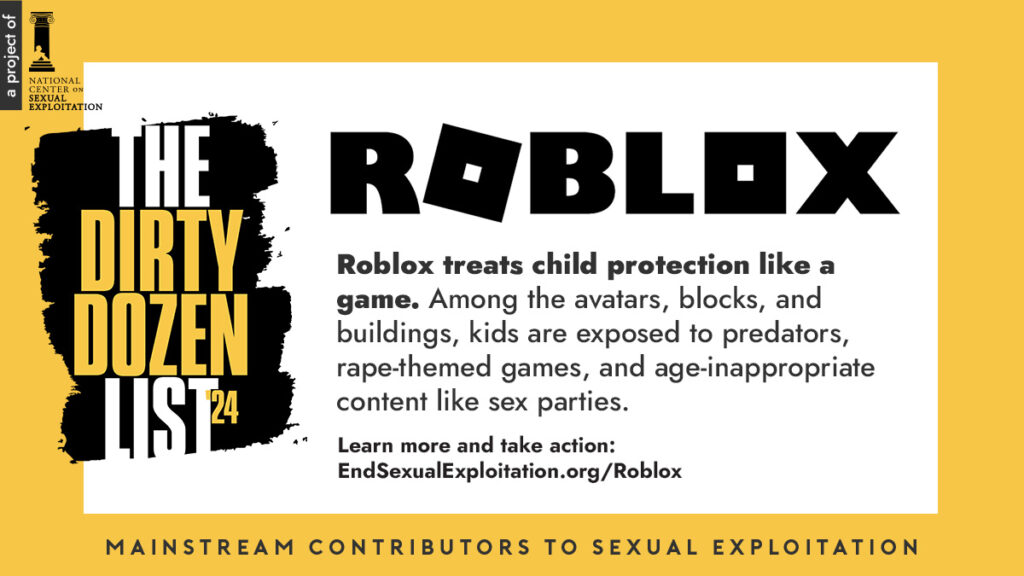
The National Center on Sexual Exploitation (NCOSE) has been calling out Roblox for years. The platform has been repeatedly featured on our Dirty Dozen List, which names mainstream corporations that facilitate sexual exploitation.
We have seen reports for years of abuse and harmful practices, including:
- Predators grooming children in chat rooms and games.
- Sexually explicit “experiences” accessible to minors.
- Minimal moderation and easy workarounds for safety controls.
These dangers are not new. They are systemic, predictable, and preventable. Roblox knows this and has chosen not to act.
Why They Can Get Away With It
Bad court decisions based on Section 230 of the Communications Decency Act have historically given online platforms like Roblox near-total immunity when children are exploited on their watch. Passed in 1996 to balance child protection with the growth of a new Internet industry, Section 230 was meant to encourage good faith moderation by shielding platforms from being sued over harmful third-party content they missed, despite their best efforts. But over time, courts have stretched it far beyond its original intent, turning it into a blanket shield that lets Big Tech profit from abuse and block safety reforms without fear of accountability.
Learn more about Section 230 of the Communications Decency Act here.
That’s why they can lobby against safety laws while their platform remains a hunting ground for predators. They believe that the law shields them.
What Must Change
It’s time to change Section 230 and pass commonsense protections like the Kids Online Safety Act (KOSA), which is expected to be introduced this fall.
KOSA would require platforms to:
- Design products with child safety as the default.
- Actively prevent and mitigate grooming, sexual exploitation, and harmful content.
- Give parents real tools to protect their kids.
Children should not have to dodge predators to play a game online. Parents should not have to fight billion-dollar companies just to keep their kids safe. And lawmakers should not be blocked by corporate lobbyists while abuse continues unchecked.
Take action today: in less than a minute you can send an email to your representatives and ask them to change Section 230
And call for the passing of the Kids Online Safety Act
Until then, Roblox will keep cashing in while kids pay the price.