The tide is turning!
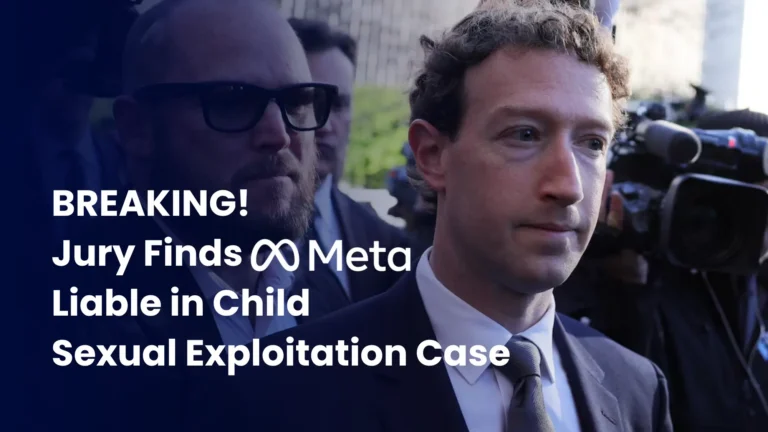
Just yesterday, we celebrated a historic victory when Meta was found liable in a New Mexico lawsuit, for failing to protect children from sexual exploitation. Now, we celebrate yet another monumental breakthrough!
The “2026 Social Media Addiction Trials,” which have captured headlines for months, have culminated in victory for the plaintiff: Kaley, a young woman who suffered severe mental health consequences throughout her childhood due to Meta and YouTube’s addictive products, has won her case!
The jury found that Meta and YouTube were negligent for operating a product that harmed kids and failing to warn users about these harms. The companies have been ordered to pay $6 million in damages to Kaley.
In two days, we have twice seen what was previously thought impossible: social media companies being held legally accountable for the harms they cause to children. For decades, Big Tech has been able to hide behind Section 230 of the Communications Decency Act—a law that courts misinterpreted as shielding tech companies from liability for the harms their products cause.
Now, that age of impunity may be coming to an end.
This is the dawn of a new era and we are beyond excited to walk into it with you. Never let it be said that change is impossible!
Decades of advocacy have brought us to this point. We are eternally grateful to you and to all the passionate individuals who changed the world by caring and refusing to accept the status quo.
🚨 Historic: A jury just held a social media company accountable for harming kids, for the FIRST time.
— Haley McNamara (@HaleyMcNamara) March 24, 2026
New Mexico won. Families won.
I served as an expert witness in this case and spoke to Meta’s failure to address child sexual exploitation despite repeated warnings from NCOSE.… https://t.co/aMnLyRTSK9 pic.twitter.com/gPHWHeRnKw
What is Kaley’s Story?
Kaley was only eight years old when she first started watching YouTube. At age nine, she began using Instagram (owned by Meta).
Soon, Kaley was spiraling into addiction. Looking back on her childhood, she describes how she would spend “every waking hour” scrolling through social media. At school, she would hide in the counselor’s office just to go on her phone.
Kaley’s mother had no idea of the extent of what her daughter could access on a phone. As far as she was aware, a phone was just for calling and texting. Once she realized what was happening, she tried to intervene. But it wasn’t easy. Kaley’s sister shared how, whenever her mother tried to take the phone away, Kaley would “have a meltdown like someone had died.”
“There became a point where she was so addicted that I could not get the phone out of her hand,” Kaley’s mother said.
Kaley’s feeds were full of content that distressed her—sexual harassment from older men, bullying from peers, hateful comments from strangers, content promoting self-harm or restrictive eating… Yet still, she couldn’t look away.
The addictiveness of social media severely damaged Kaley’s mental health, even fueling suicidal thoughts.
And what’s most disturbing is that Meta and YouTube intentionally designed their products to addict children like Kaley. They knew full well the scale of harm they were causing to young users—and they prioritized profit over children’s wellbeing and lives.
Read more about the evidence uncovered during the trials here.
What Does this Victory Mean for Other Plaintiffs?
The 2026 Social Media Addiction Trials involve a large collection of lawsuits from thousands of plaintiffs—including families, school districts, and local and state governments and attorneys general.
Kaley’s was the first bellwether trial for this collection of cases.A “bellwether trial” is used to test how a large group of similar lawsuits will play out. So, the fact that Kaley’s suit reached this victory is incredibly hopeful for the remaining plaintiffs whose cases are soon to be tried.
Further, it spells hope for the countless victims of social media who, until now, have been shut out of the courtrooms by Section 230 of the Communications Decency Act.
Together with the victorious New Mexico lawsuit, this jury’s verdict has the power to change the course of history.
Add Your Voice to the Cause
Join us in calling for accountability for social media companies!
On March 31, NCOSE is launching the 2026 Dirty Dozen List—an annual campaign that calls out 12 mainstream corporations and institutions for facilitating and profiting from sexual exploitation. Meta, YouTube, and numerous other tech companies have all been named to the list in previous years.
Want to find out who this year’s 12 targets are? Join us for the Dirty Dozen List Reveal Event, Tuesday March 31st at 1:00 pm EST!
Following the Reveal Event, you will be provided with quick and easy actions, through which you can contact these companies directly and urge them to change.
We look forward to making many more victories with you!