Last year, U.K. Member of Parliament William Wragg was blackmailed into sharing his colleague’s personal information with a scammer. How did the scammer get Wragg to do this? By threatening to share “compromising images” of him.
The scammer had courted Wragg on a dating app—but it was nothing but a ploy to steal sensitive information.
What happened to Wragg is called sextortion.
Sextortion is a rampant crisis affecting 1 in 4 minors and 1 in 7 adults. And it poses a threat not only to individuals, but to national security.
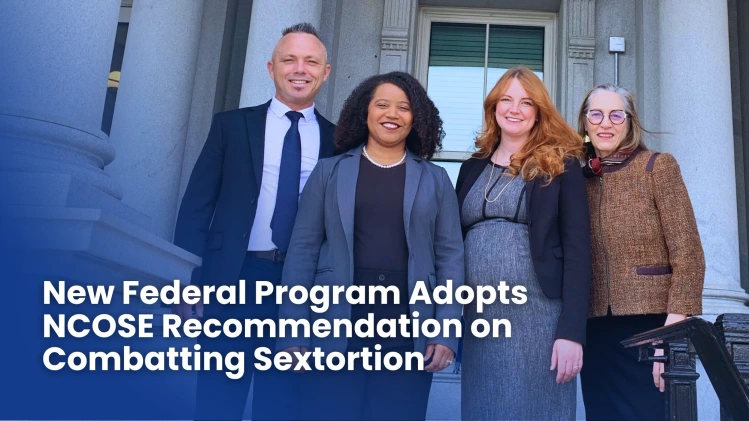
On Friday, November 7, 2025, the National Center on Sexual Exploitation (NCOSE) was invited to the White House to deliver a briefing on sextortion to Homeland Security, the National Security Council, and other senior leaders.
This invitation marks a major milestone. Thanks to your steadfast support, the highest levels of our government are now turning their attention to the grave threat of sextortion. We stood before these decision-makers and delivered a clear, urgent message: we must act now to dismantle the criminal networks profiting from this devastating form of abuse.
Read on for a summary of the information and recommendations we presented to the White House.
Organized Sextortion: Who Are the Perpetrators?
Sextortion involves threatening to expose sexual images of someone if they don’t yield to demands. The images may be AI-generated, stolen, coerced, or originally consensually shared with a specific individual.
Individuals regularly use sextortion for abusive purposes, such as using it to coerce a person into further sexual abuse, creation of explicit materials, or financial payment.
Increasingly, transnational organized criminal networks are also driving sextortion at scale, putting both personal safety and national security at risk.
Before the briefing, we connected with our global network, gathering insights from on-the-ground investigators and specialists who are confronting overlapping forms of sexual exploitation every day. Our research, presented to the White House, exposes a complex web of international and domestic criminals.
We identified several groups driving this crisis on the transnational level. This included discussion of West African syndicates with networks spanning Nigeria, Ghana, Côte d’Ivoire, and beyond. They often use hierarchical structures and exploit migrant networks and social media for recruitment, and use sextortion funds as income to support other criminal activities. We also discussed how many of these networks have opportunistic, market-driven connections to Chinese criminal networks. These collaborations often use Africa as a transit hub, creating a more complex and resilient criminal ecosystem.
We also discussed domestic sextortion carried out by individuals and domestic organized crime as well, including alarming recent reports of state prison inmates running sextortion operations behind bars with the use of cell phones.
Who is Victimized?
We have long been sounding the alarm on how minors are being targeted by sextortion, especially teenage boys. In 2024, 1 in 4 young people reported experiencing sextortion as a minor. Teenage boys account for 90% of financial sextortion cases involving minors.
It is imperative to continue pressing on how this abuse affects minors. At the same time, we must not forget that adults are victimized too. A 10-country survey found that 1 in 7 adults have been threatened with the distribution of sexual images depicting their likeness.
Adults are often an underreported victim group due to shame and fear of social repercussions, yet they are high-value targets due to their financial resources. Further, when targeted adults work in sensitive government roles, sextortion becomes a direct threat to our national security.
How Big Tech and FinTech Fuel the Crisis
The tech industry, including financial technology (FinTech), is a key enabler of sextortion. Tech platforms are often designed in dangerous ways, allowing predators to easily contact and groom children. Further, the companies often neglect to respond to sextortion reports effectively, or to systematically remove illegal material that facilitates the abuse (for example, training manuals for sextortionists).
Finally, in the age of AI, many technology tools now allow users to create AI-generated sexual images. What this means is that perpetrators do not even need to obtain a sexual photo of their target in order to sextort them. They can simply use AI to generate one.
In short: everyone is at risk.
Our Recommendations for Action
Presenting the problem was only half our mission. We went to the White House with a bold, actionable plan to dismantle these criminal networks and protect Americans. We are urging the administration to take decisive steps to combat organized sextortion.
Our key recommendations include:
- Strengthen Global Accountability:
We urged the U.S. to expand its international reporting and diplomacy tools so that countries are evaluated on how effectively they address sextortion, helping create a stronger global framework for prevention and enforcement. - Use Executive Leadership to Coordinate Action:
We called for a strong federal directive that unifies agencies and engages major tech and financial platforms in adopting best practices to combat sextortion. - Tie Support to Measurable Progress:
We recommended conditioning certain forms of foreign assistance on demonstrated improvements in investigating and prosecuting sextortion networks. - Increase Support in High-Risk Regions:
We emphasized the need for more resources for frontline partners—particularly in parts of Africa where many of these networks operate—and to link that support to clear cooperation and enforcement benchmarks. - Disrupt Criminal Networks More Aggressively:
We proposed innovative disruption strategies that weaken the operations, cohesion, and financial infrastructure of sextortion rings.
This is Just the Beginning. Join Us.
This White House briefing was a powerful step forward, made possible by supporters like you who believe in a world free from sexual exploitation. But our work is far from over. Now that we have the attention of our nation’s leaders, we must increase the pressure and demand meaningful, lasting change.
Your voice and your support are our most powerful weapons. Help us continue this fight. Support NCOSE’s mission to hold powerful institutions accountable and protect the vulnerable from mass-scale sexual abuse and exploitation. Together, we can turn this moment of opportunity into a movement for justice.