At only 11 years old, J.F. downloaded Snapchat without her parents’ knowledge. It wasn’t difficult. All she had to do was lie about her birthday.
A few months later, Snapchat recommended that a 25-year-old sexual predator, Valentin Rios, connect with J.F. through its “Quick Add” feature. This predator had also connected with others minors in the area, so J.F. thought they shared mutual friends. After all, Rios portrayed himself as a high school boy.
This is how the grooming began. Rios sent J.F. nude photos and coerced her to send some in return. Through Snapchat’s “Snap Map” feature, he was able to locate her home address. And the unthinkable happened next.
Rios convinced J.F. to sneak out of her house one night and upon meeting up, he raped her.
This child’s rape could have been prevented, and Snapchat knew it. Prior to the assault, NCOSE and others had already warned Snapchat of the way features like “Quick Add” and “Snap Map” were being used to facilitate child sexual exploitation. But Snapchat refused to act.
Not only did Rios rape this young girl, he was connecting with thousands of minors on Snapchat, falsely claiming he was a friendly, high school boy.
Snapchat is on NCOSE’s 2026 Dirty Dozen List because, even all these years later, many of the same problems that led to J.F.’s assault have not been rectified.
Snapchat’s Dangerous Features and Failure to Take Action are a Recipe for Exploitation
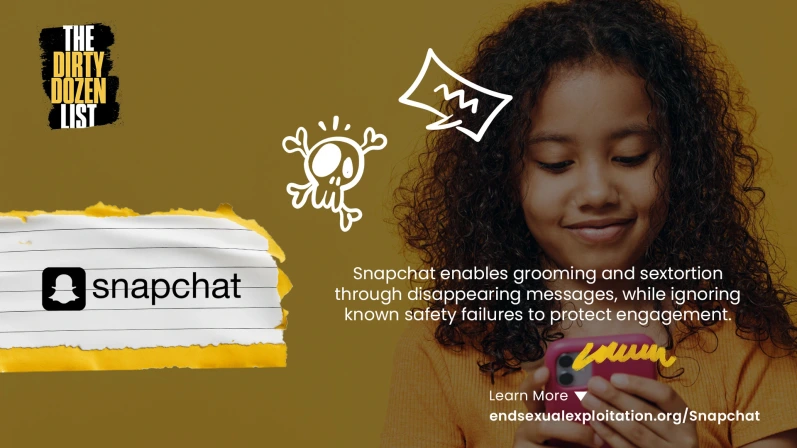
Snapchat is notorious for its disappearing image feature, where users can send images and videos that disappear, seconds after they’ve been shared. This design predictably makes it a popular app for sexting, further enabled by the “My Eyes Only” section where users can privately share or store pornographic images. Even parents cannot access images in their child’s “My Eyes Only” section, unless their child gives them the pin.
Snapchat also known for other dangerous features including the “Snap Map,” which allows users to view the location and activity of their friends, and “Find Friends” (formerly called “Quick Add”), a feature that suggests people for users to add as friends with one simple tap.
These features are precise reasons why predators flock to this app to groom and exploit children.
In fact, according to the complaint by J.F.’s family, in 2024, Snap executives received a 133-page manual, originally published on the dark web, which details how to use Snapchat’s unique features to groom and exploit minors. The complaint states that the manual coaches predators on how to use “Find Friends” and “Snap Map” to connect with victims.
The lawsuit filed by J.F.’s family also revealed internal documents from Snapchat, which showed that at time the of the assault, Snapchat was failing to review over 40% of “serious user reports.”
Given all of this, it makes you wonder: If Snapchat had reacted appropriately to warnings and user reports, could this tragedy have been avoided?
Five Years Later and Snapchat is Still Dangerous
Snapchat is on the 2026 Dirty Dozen List because it has not made the necessary changes to protect kids. Even five years after J.F.’s assault, the platform has not done much to prevent it from happening again.
According to a 2025 report from Thorn, Snapchat was the #1 platform used for sextortion, as identified by victims. Furthermore, a lawsuit against Snapchat filed by the State of New Mexico found that the company was receiving around 10,000 user‑reports of sextortion per month. Yet many reports apparently went unresolved or uninvestigated. This same lawsuit also uncovered internal documents which showed blatant rejection of safety measures because they hurt the company’s bottom line.
Snapchat’s introduction of the “My AI” chatbot has also caused severe concern over its conversations with children. A lawsuit filed by the state of Utah alleges that the My AI chatbot was “giving misleading or harmful advice to underage users, including how to hide alcohol and drugs or set the mood for a sexual experience with an adult [i.e. statutory rape].”
While Snapchat has implemented some safety measures, including warnings for messages from strangers and restrictions on friend requests, they fall short of addressing the platform’s systemic issues. Many of these features rely on users recognizing risks and taking action, which is unrealistic for minors who may not fully understand the dangers or feel pressured to not report abuse.
To learn more about the dangers posed by Snapchat and take action, visit DirtyDozenList.org/Snapchat.