As a mother, Lorraine (pseudonym) was well aware of the dangers children could be exposed to online. So, she took great care to monitor and lock down her 14-year-old daughter’s tech devices.
At times, Lorraine worried she was “overparenting.” She fretted that her daughter was missing out on fun and healthy social interactions, because her friends all had social media.
But even with Lorraine worrying that she was doing too much … in the end, it still wasn’t enough.
Sexual predators reached Lorraine’s daughter anyway. How? Through the girl’s school-issued Chromebook.
Google Chromebooks Put Back on the Dirty Dozen List
Lorraine’s daughter is only one of many children who have been exposed to sexual predators or other harmful experiences on school-issued Chromebooks. It is for this reason that NCOSE has once again named Google Chromebooks to our annual Dirty Dozen List.
This is a sad decision for us, as we removed Google Chromebooks from the Dirty Dozen List in 2021, celebrating and applauding safety changes they made. While we remain grateful for those changes, evidence has continued to compile over the years that Chromebooks are still a highly dangerous place for kids.
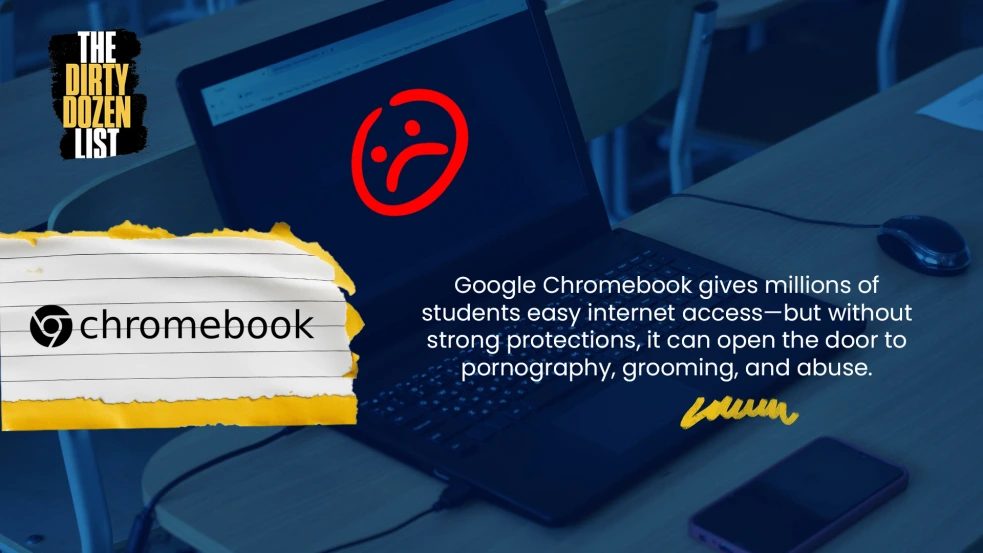
The Central Problem: Open Internet Access
The central problem is that Chromebooks grant students open access to almost the entire Internet. There, any number of harms are ready to greet them: grooming from sexual predators, exposure to hardcore pornography, cyberbullying, sextortion, and more.
For a school-issued device intended for education, this is unacceptable. Google Chromebooks should only allow access to specific, vetted websites that are deemed to be both educational and age-appropriate.
For example, the sexual predators who groomed Lorraine’s daughter did so through the gaming platform Roblox. But why was a school-issued Chromebook allowing students to access a platform like Roblox anyway? It is neither educational nor safe. Attorneys general, police, child safety advocates, researchers, and reporters have all frequently warned that Roblox is rife with child predators.
This is just one example of why Chromebooks should be restricted to vetted, educational websites.
Further, beyond Chromebooks merely allowing children to access harmful sites and material, some have claimed that Google actively pushes this content to kids. This is because, as explicated in a 2025 lawsuit against Google, their search algorithms are “designed to promote maximally ‘engaging’ content and communications”—and as you can probably imagine, engaging does not always mean appropriate or healthy.
Complicated and Overwhelming Safety Controls
Google Chromebooks offer optional safety settings through the “Admin Console.” However, there are several problems with this console. A lawsuit filed by a minor who was sexually abused as a result of her Google Chromebook aptly explains the issues:
“Google provides tools that, if used, can make its Products somewhat less dangerous, but schools must pay extra for them. And settings within its Admin Console may be reconfigured to make the Products less dangerous, but they are overwhelming: potentially numbering over a thousand, they are ever-changing and difficult to navigate. Thus, Google’s Products are designed in a manner that is dangerous and difficult to reconfigure. They could and should be made safe out of the box. [emphasis added.]”
Imagine if toy companies marketed products to children but put them on the shelves in a highly dangerous state. Then, they required caregivers to pay extra for the privilege of making the products actually child-friendly, and required them to spend hours upon hours constantly monitoring and maintaining the safety features? This is what Google is doing with its K-12 Chromebooks.
Children Exposed to Hardcore Pornography
In addition to the danger of sexual predators, Chromebooks routinely expose children to hardcore pornography. NCOSE has heard from numerous parents this year alone whose children experienced this.
These parents shared how their child easily bypassed the Chromebook filters to access pornography, often even during class-time. In 2022, a demographically representative, national survey from Common Sense Media noted that 41% of teens have seen pornography during the school day, and of these, nearly half (44%) watched it on school-owned devices.
Scientific research indicates that pornography exposure has numerous harmful effects on children, from increasing their risk of experiencing or perpetrating sexual abuse, to hurting their mental health and hindering their learning. This is a problem that must be addressed.
What Does Google Need to Change?
Together with grassroots advocates like you, NCOSE is calling on Google to make the following safety changes to their Chromebooks:
- Redesign Chromebooks with a safety-first approach, including robust, default and locked safety settings that limit internet access to vetted, educational, age-appropriate content.
- End exploitative data collection by halting student data harvesting without parental consent and ensuring full transparency and parental control over collected data
- Implement hardware-level controls to block students from bypassing safety and school-administered restrictions.
- Enable effective offline functionality to reduce reliance on constant internet access and limit exposure to online risks.
- Simplify and improve administrative tools, making the Admin Console user-friendly with intuitive, standardized safety settings activated by default.