For years, NCOSE has said the same thing to Big Tech: you have the tools to make app stores safer for kids … you simply need the will to use them. This week, Google proved our point.
What Google Just Announced
On July 29, 2026, Google Play announced it is expanding its Play Age Signals API to all developers globally. The tool has already been available in Brazil, and Google says it will expand to users in Australia and Canada by mid-August, with a full global rollout later this year.
Here’s how it works: the Play Age Signals API is a privacy-preserving tool that lets parents share their child’s age range directly with apps, and lets adults share their own age when an app asks for it. In turn, app developers receive the signal they need to tailor content, features, and settings to match the age of the person using their app instead of applying the same experience to a 13-year-old and a 43-year-old alike.
Google is also centralizing this for parents. Age-sharing controls now live inside their Google Family Link app, and once a parent chooses to share a child’s age range, every Play app using the Age Signals API can receive that signal, meaning parents no longer have to configure settings app-by-app. Parents can turn the setting off at any time.
While this is progress, it’s important to note there are still gaps for safety. Importantly, age ranges are never shared by default. This requires a parent to first know that this tool exists, then download the special Google Family Link app, and set it up. This leaves minors without the privilege of involved, tech-savvy parents completely unprotected from predictable harms and risks of apps that treat them like adults.
Still, this is genuinely good news. It is also proof of something we’ve been saying for a long time: when legislators apply real pressure, Big Tech suddenly discovers it had the technology all along.
Why This Is Happening Now: The App Store Accountability Act
For years, NCOSE has championed the App Store Accountability Act (ASAA), a simple, common-sense bill that says a corporation should not be able to enter a binding legal agreement with a child without a parent knowing about it. Every time a child taps “I Agree” on an app, they may be handing over access to their photos, location, contacts, camera, biometric data, and more. ASAA changes that by requiring:
- Parental consent before every download or in-app purchase a minor makes.
- Honest, accurate app ratings that reflect what an app actually does, not what a developer claims, with legal consequences for ratings that mislead.
- Age verification using tools app stores already have. As NCOSE has pointed out, app stores already collect birthdates, link accounts to credit cards, and manage family relationships through tools like Apple’s Family Sharing and Google’s Family Link. ASAA doesn’t invent new technology; it simply requires companies to use what they’ve already built.
This bill does not ban any app or app category, does not require anyone to upload a government ID, does not restrict what adults can access, and does not regulate speech or content. It simply closes a loophole that has let app stores treat children’s contracts differently than every other contract a minor can’t legally sign alone.
Parents have already won this fight in four states — Utah, Texas, Alabama, and Louisiana — and momentum is building in statehouses across the country.
Big Tech, predictably, went to court. In Texas, industry groups representing Apple and Google sued to block the state’s version of ASAA (Senate Bill 2420) on First Amendment grounds. But the U.S. Supreme Court declined to block the law, allowing Texas to continue enforcing its App Store Accountability Act while the case proceeds on the merits before the Fifth Circuit. That means today, in Texas, app stores are living under the very accountability rules Big Tech insisted they couldn’t comply with.
Sound familiar? It should. Just weeks after that ruling, Google rolled out a global age-signal tool it says will help “developers… deliver age-appropriate experiences.” Funny how quickly innovation appears once a state proves the law will actually be enforced.
Apple Moved First, And the Pressure Is Working There Too
Google isn’t the only company suddenly discovering it can do more. In June 2025, Apple announced a similar suite of updates arriving with iOS 26: a simplified Child Account setup process, a new Declared Age Range API that lets parents share a child’s age range with apps without exposing their birthdate, expanded protections for teens 13–17 that mirror what younger kids already get, more granular App Store age ratings (adding 13+, 16+, and 18+ tiers), and a new PermissionKit framework that lets kids send parents a request before communicating with a new contact in an app. Apple also said App Store product pages will now reflect when a developer indicates their app includes user-generated content, messaging, advertising, or in-app safety controls.
That last point matters, and parents should read the fine print carefully: Apple does not say developers will be required to disclose this information, only that if a developer chooses to disclose it, the information will appear on the app’s product page. Likewise, Apple does not require developers to actually use its new age-assurance tools, like the Declared Age Range API. They are available if a developer chooses to adopt them. Nothing in Apple’s announcement makes any of this mandatory.
Progress, But Not Yet Protection
Here’s the bottom line: all the pieces of the infrastructure are now sitting on the table. Google has a global age-signal system. Apple has a Declared Age Range API and more granular ratings. Both companies have finally admitted, in their own words, that privacy-preserving age assurance is possible at scale.
What’s still missing is the one thing ASAA would provide and voluntary corporate policy never will: a requirement. Right now, whether a developer discloses accurate content information, whether a developer uses an age-signal API at all, and whether a parent’s “share age” setting actually reaches every app a child downloads, all of it depends on a patchwork of individual company choices that can change, be ignored, or quietly dropped when legislators stop watching. A child’s safety should never depend on whether a random developer decided to flip a switch.
That’s why NCOSE believes the age signal should always be shared for minors, automatically, every time, so that human error and corporate inconsistency never stand between a child and the protections that already exist.
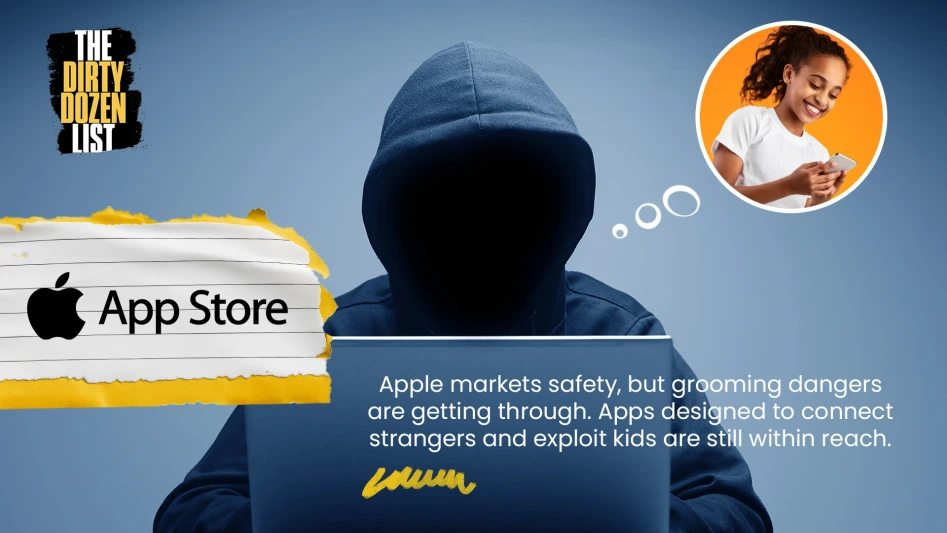
And here is the piece Apple and Google still haven’t fixed: neither company gives parents an actually accurate age rating to consent to in the first place. Ratings are still built almost entirely on what a developer self-reports, not on what an app actually does once a child opens it. A rating of “12+” or “4+” can still sit on top of an app with open chat with strangers, AI companions, live-streaming, or a direct pipeline to pornographic content, because no one independently checked. When a parent taps “allow,” they believe they are consenting to something age-appropriate. In reality, they are often consenting based on false and misleading information the app store itself supplied.
This is directly tied to how children are being exploited today. Predators and bad actors specifically seek out apps with lax or mislabeled ratings, knowing they offer an easier path to a child than a well-rated, closely monitored one. A misleading “safe for kids” rating actively lowers a family’s guard at the exact moment they should be paying the most attention. That is why ASAA’s requirement of honest, legally enforceable ratings is one of the most urgent child-protection pieces of the entire bill.
So now it the time to take action.
Google and Apple just proved the technology is ready. Now the law needs to catch up nationwide.
TAKE ACTION: tell your state lawmakers to pass the App Store Accountability Act.
You can also find your toolkit at AppStoreAct.org. Help make your state the next one where parents, not app store terms of service, decide what’s safe for their kids.